
German and American roaches look different, live in different places, and require different treatment. German roaches breed indoors and need interior baiting to eliminate, while American roaches come in from drains and crawl spaces and are handled with exclusion and exterior work.
Getting the identification right is the whole game. Treating a German roach problem like an American roach problem, or the reverse, is the most common reason a treatment fails.
This guide shows how to tell them apart in Dacula homes, why German roaches are the harder of the two to kill, and how professional cockroach control adjusts by species. For the broader DIY-versus-professional comparison, see our guide on how to get rid of roaches in Georgia.
German vs. American Roaches at a Glance
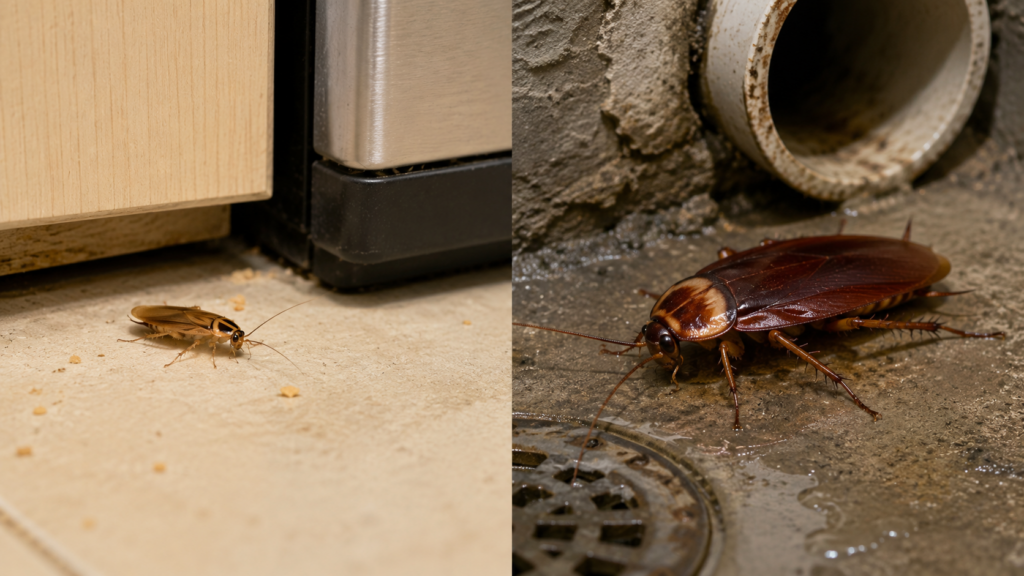
Start with size. If the roach is small enough to sit comfortably on a quarter, it is almost certainly German. If it is long enough to make you step back, it is American.
| Feature | German Cockroach | American Cockroach |
| Size | About 1/2 inch | 1.5 to 2 inches |
| Color | Tan to light brown | Shiny reddish-brown |
| Markings | Two dark parallel stripes behind the head | Pale yellowish band around the head shield |
| Where it lives | Indoors, full life cycle | Drains, sewers, crawl spaces, mulch |
| Typical rooms | Kitchens, bathrooms, inside appliances | Basements, utility rooms, garages |
| How it gets in | Carried in on boxes, bags, used items | Enters through drains, gaps, foundation cracks |
| Reproduction | Fast; infests indoors | Slower indoors; usually breeds outside |
| Main treatment | Interior baiting and growth regulators | Exclusion, drain and exterior treatment |
There is a practical shortcut. American roaches are wanderers, so you tend to see one at a time, often near a drain or after heavy rain. German roaches are colonizers, so you tend to see several, and you find droppings and egg cases where they hide.
Why German Roaches Are the Hardest to Kill
German roaches are the species that turns into a months-long problem, for three reasons that build on each other.
The first is reproduction. According to the Environmental Protection Agency, a female produces four to eight egg capsules over her life, each carrying roughly 40 eggs that hatch in about 28 to 30 days. She carries the capsule until the eggs are nearly ready, which protects it from most treatments.
The second is insecticide resistance. Most retail sprays rely on pyrethroids, and German roach populations have been developing resistance to them for decades. Rutgers Cooperative Extension notes that these ready-to-use sprays and aerosols are not as effective as bait, precisely because of resistance and repellency.
The third is behavioral, and it surprises people. North Carolina State University entomologists have documented German roaches that inherited an aversion to glucose, the sugar used to make many baits palatable. Those roaches simply refuse the bait, which is why professionals rotate bait products rather than reapplying the same one.
Stack those together and you get a population that survives sprays, ignores some baits, and replaces its losses within a month. That is not a housekeeping failure. It is biology.
It also explains why the same product can work in one home and fail in the next. Resistance and bait aversion vary by population, so a technician who monitors results and switches products mid-plan will clear a home faster than one repeating a single application.
Where Each Species Hides in a Dacula Home
Knowing where to look tells you which species you are dealing with, even before you catch one.
German roaches stay close to warmth, moisture, and food. Look inside and behind the refrigerator and dishwasher, under the sink, in the motor housing of small appliances, along cabinet hinges and drawer runners, and in the gap between the stove and the counter. They rarely travel far from that core area.
American and smokybrown roaches take the opposite approach. They live in floor drains, sewer lines, crawl spaces, mulch beds, gutters, and wood piles, then move indoors through plumbing penetrations, foundation cracks, and gaps under exterior doors. In Dacula, wooded lots and heavy summer storms drive that movement, especially in late summer.
What About Smokybrown Roaches?
A third species turns up often enough in Dacula to be worth naming. Smokybrown roaches are large like American roaches, around an inch and a quarter, but a uniform glossy dark brown without the pale head marking.
They are strongly tied to moisture and organic debris outdoors, which means gutters packed with leaves, mulch beds against the foundation, wood piles, and tree hollows. They are also strong fliers and are drawn to exterior lighting, so they often appear on porches and near doors at night before working their way inside.
For treatment purposes, group them with American roaches. The work is exterior: clean the gutters, pull mulch back from the foundation, correct drainage, and seal the gaps they use. Treating indoors alone will never keep up with an outdoor breeding site.
Why DIY Fails Differently for Each Species
DIY products fail against both species, but for different reasons, and understanding that saves money.
Against German roaches, sprays fail because they only kill what they touch. The nest sits inside a wall void or appliance housing, untouched, and the egg capsules are protected. Worse, spraying near bait stations contaminates the bait, so roaches avoid the one product that could have reached the colony.
Against American roaches, retail products fail because the source is outdoors. You can kill every roach in the basement and still get new ones next week, because they are breeding in a drain, a mulch bed, or a crawl space and simply walking back in. Without exclusion and exterior work, the supply never stops.
This is why species identification is not academic. It determines whether the real work happens inside your kitchen or around your foundation.
How Professional Treatment Differs by Species
A technician builds the plan around what was identified during the inspection.
| Step | German Roach Plan | American Roach Plan |
| Focus | Interior harborage | Entry points and exterior sources |
| Primary method | Gel baits and growth regulators | Exclusion, drain and perimeter treatment |
| Product handling | Rotate baits to beat resistance | Target breeding sites outdoors |
| Key areas | Appliances, cabinets, wall voids | Drains, crawl spaces, mulch, gutters |
| Follow-up | Essential; catches newly hatched roaches | Focused on sealing and moisture correction |
Both plans include moisture correction, because damp conditions are what sustain either species. Both also include follow-up visits, though for different purposes: with German roaches, follow-up catches the generation that hatched after the first treatment, while with American roaches it confirms the entry points stayed closed.
Why Species ID Changes Everything
German and American roaches are easy to tell apart once you know what to look for. Size, markings, and location give it away in seconds.
That identification then dictates the entire approach. German roaches call for interior baiting, bait rotation, and follow-up, because the population lives and breeds inside. American roaches call for exclusion and exterior work, because the population lives outside and keeps walking in.
Treating the wrong species wastes months. Identifying it correctly, then matching the method to the biology, is what actually clears a home. The questions below cover what Dacula homeowners ask most.
FAQs
How do I tell a German roach from an American roach?
Size is the fastest test. German roaches are about half an inch with two dark stripes behind the head. American roaches are 1.5 to 2 inches, shiny reddish-brown, with a pale band around the head shield.
Which roach is worse to have?
German roaches. They complete their entire life cycle indoors, reproduce quickly, and resist many retail products. American roaches are larger and more alarming to see, but they usually breed outdoors and enter opportunistically.
Why do German roaches keep coming back after treatment?
Egg capsules are protected while the female carries them, so a new generation can hatch after the first treatment. Some populations also resist pyrethroid sprays or refuse glucose-based baits, which is why bait rotation and follow-up visits matter.
Do American roaches infest homes?
They can survive indoors, but they typically breed outside in drains, mulch, crawl spaces, and gutters, then move in through gaps and plumbing. Control focuses on sealing entry points and treating those outdoor sources.
Does the species change the treatment cost?
It can. German roach infestations usually require more visits and interior baiting, which costs more than the exclusion and exterior work that resolves most American roach problems. A free inspection gives you an accurate quote.
Can I identify the species myself?
Often, yes, using size and markings. If you are unsure, or if you find droppings and egg cases in the kitchen, contact Arete Pest Control and a technician will confirm the species during a free inspection.