
Utah is home to 621 spider species, but only two pose medical risks: Western black widows (Latrodectus hesperus) and desert recluse spiders (rare, primarily southern Utah).
While not considered poisonous, Wolf spiders, hobo spiders, and yellow sac spiders can cause painful bites that can lead to medical emergencies.
Understanding how to identify poisonous spiders, their seasonal behavior, and prevention helps protect Salt Lake County and Utah County residents from bites while maintaining beneficial spider populations that control insect pests.
Which Spiders in Utah are Poisonous?
Two spiders in Utah are considered poisonous and require immediate medical attention if you experience a bite.
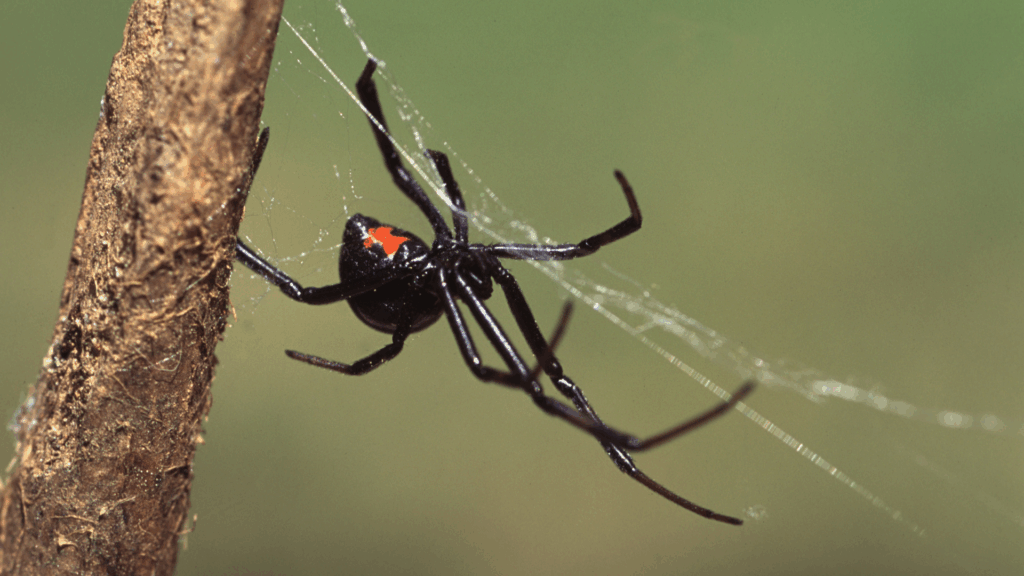
1. Western Black Widow (Latrodectus hesperus)
The Western black widow is the most common dangerous spider in Utah and the one responsible for the majority of serious spider bites statewide.
- Identification: Shiny jet-black body with a distinct red or orange-yellow hourglass marking on the underside of the abdomen.
- Webs: Irregular, tangled, and messy “cobwebs,” usually built low to the ground in dark, undisturbed areas.
- Traits: They are nocturnal and shy, often nesting in window wells, garages, and woodpiles.
- Bite Symptoms: Black widow bite appearance often begins as mild redness but progresses within hours to severe muscle cramps, abdominal rigidity, nausea, sweating, and elevated blood pressure due to neurotoxic venom. Symptoms can last 24–72 hours and require medical evaluation.
2. Desert Recluse (Loxosceles deserta)
The desert recluse is frequently confused with the brown recluse, but true recluse populations are limited in Utah and are rare outside southern desert regions.
- Identification: Small (1/4 to 1/2 inch) with a tan or light brown body and a dark violin-shaped marking on the head region. They have only six eyes arranged in pairs.
- Traits: These are extremely rare and primarily found only in the warm, southern regions of Utah. They are not naturally occurring in Northern Utah (Salt Lake or Utah counties).
- Bite Symptoms: Their venom is necrotic, meaning it can destroy tissue. Bites may initially appear minor but can develop into slow-healing sores over several days. Medical evaluation is recommended if symptoms worsen.
Common Northern Utah Spiders That Are Not Medically Dangerous
Beyond black widows, several large or fast-moving spiders in northern Utah are frequently labeled “dangerous.” In reality, these species are not medically significant, though they can deliver painful bites if handled or trapped against the skin.
Yellow Sac Spiders (Cheiracanthiidae)
Yellow sac spiders are among the most common indoor spiders in Salt Lake and Utah Counties. They are small (about ¼ inch), pale yellow or cream-colored, and often seen wandering on walls or ceilings at night.
Unlike web-building spiders, they actively hunt insects and build small silken “sacs” in the corners of the upper wall, where they rest during the day.
Their bites can be painful and may cause redness, swelling, and a burning sensation for several days.
While symptoms are uncomfortable, their venom is not medically dangerous. Yellow sac spiders are more defensive than most house spiders and may bite if trapped in clothing or bedding.
Wolf Spiders
Wolf spiders are among the most commonly encountered spiders in northern Utah and are frequently mistaken for brown recluses due to their brown coloration.
In reality, wolf spiders are considered harmless but can be frightening to look at.
They are large, fast-moving, and covered in dense hair, often measuring up to two inches in length, including leg span. Unlike web-building spiders, wolf spiders actively hunt their prey and are commonly seen running across garage floors, basements, and foundation areas.
Wolf spider bites can be painful and may cause temporary redness and swelling, but they do not cause necrosis or systemic reactions.
Camel Spiders (Solifugae)
Camel spiders, sometimes called wind scorpions, are not true spiders but arachnids. They are most common in the southern and desert regions of Utah, but they occasionally generate statewide concern due to their size and speed.
They lack venom glands and pose no serious medical threat. However, they have strong jaws and can deliver a painful bite if provoked.
Their large appearance and fast movements often cause unnecessary alarm, but they do not seek out humans and are not aggressive predators of people.
Huntsman Spiders
Huntsman spiders are large, long-legged spiders that can appear intimidating. They are not common household spiders in northern Utah but may occasionally be encountered in garages, sheds, or woodpiles.
They prefer cracks, bark, and protected structural voids. Huntsman spiders can bite if handled, but bites are not medically significant. Their size and speed are their most alarming traits, not their venom.
Hobo Spiders
Hobo spiders are very common in northern Utah and are often mistakenly believed to be dangerous. Earlier reports suggested their bites could cause necrotic skin lesions, but modern research has disproven those claims. Hobo spiders are not considered medically significant.
They are medium-sized brown spiders (about ½ to ⅝ inch body length) with long legs and solid-colored legs lacking dark bands. Hobo spiders build funnel-shaped webs close to the ground, commonly found in window wells, foundation cracks, basements, and rock landscaping.
They are fast runners but poor climbers, which is why they are typically seen at floor level rather than on ceilings. While a bite may cause temporary redness or mild swelling, it does not result in tissue death or serious systemic symptoms.
In Salt Lake and Utah Counties, hobo spiders are frequently misidentified as brown recluse spiders. Proper identification is important, as true brown recluses do not naturally occur in northern Utah.
Why Am I Seeing More Spiders in My Utah Home in the Fall?
While spiders are commonly found in homes during every season, increased fall spider activity in Utah is due to three main factors:
- Mating Cycles: Mature males wander indoors searching for mates, while females seek protected spots to lay eggs.
- Seeking Shelter: As temperatures drop below 50°F, spiders move into warm basements, garages, and attics.
- Following Prey: Spiders move inside to hunt common household pests like ants and boxelder bugs.
According to the USU Extension, this is a shift in movement rather than a population spike, as many species simply move indoors to overwinter.
Do Spiders in Utah Come Inside During the Winter?
Most spiders seen inside Utah homes during winter were already indoors, as they were born there. Indoor spider species (cellar spiders, house spiders, some wolf spiders) adapt to year-round indoor living in quiet, undisturbed locations.
While some spiders, including Hobo Spiders and Wold Spiders, seek shelter indoors, most do not.
Spider Prevention Tips in Salt Lake County and Utah County
Effective spider prevention in northern Utah focuses on eliminating harborage areas, sealing entry points, and reducing insect populations. Spiders enter homes for two reasons: shelter and food. Remove those two factors, and spider activity declines.
Seal Structural Entry Points
Spiders enter through small gaps around foundations, siding, windows, and utility penetrations. Use these exclusion measures to physically block spiders from entering your property.
- Caulk cracks around window frames and foundation lines
- Install tight-fitting door sweeps (no more than ¼-inch gap)
- Seal gaps around pipes, vents, and cable lines
- Repair torn window screens
Even small structural gaps allow spiders and the insects they prey on to enter.
Prioritize Window Wells
Window wells are the most common black widow nesting site in Salt Lake County and Utah County. To seal window wells, follow these tips:
- Install clear window well covers
- Add 3–4 inches of drainage gravel
- Remove leaves and debris monthly
- Wear gloves when cleaning
Window wells create dark, undisturbed conditions ideal for black widows and hobo spiders, which is why they are often the first location exterminators to inspect for spider activity.
Reduce Garage and Basement Harborage
Garages and basements provide low-light, low-traffic environments that spiders prefer. Avoid clutter that creates shelter for spiders by:
- Storing shoes in sealed containers
- Avoid stacking cardboard boxes directly on floors
- Keeping firewood at least 20 feet from the home
- Vacuuming corners and ceiling joists regularly
- Removing cobwebs before egg sacs hatch
Black widows commonly nest in garage door L-corners, inside stored items, and beneath unused equipment.
Control Insect Populations
Ants, flies, crickets, and boxelder bugs attract hunting spiders such as wolf spiders and yellow sac spiders. To reduce insect populations, make these modifications to your home:
- Reduce exterior lighting that attracts insects
- Use yellow bulbs or motion-activated lighting
- Seal food containers and reduce indoor crumbs
- Address ant or fly activity promptly
As insect populations decline, spider populations will follow.
Maintain Exterior Landscaping
Landscaping directly against foundations increases spider activity.
- Keep shrubs trimmed at least 12 inches from the home
- Remove excess mulch from window wells
- Clear leaf litter and debris from foundation lines
- Avoid storing lumber or debris against exterior walls
Spiders overwinter under bark, rocks, and woodpiles. Keeping landscaping clean reduces migration toward the structure.
Spider prevention in Utah is primarily focused on habitat modification, not heavy chemical treatment.
Most spiders are actually beneficial and help control pests. However, when black widows are present in garages, window wells, or crawl spaces, professional spider removal is recommended to reduce the risk of medical complications.
Targeted prevention combined with seasonal inspections provides the most reliable long-term protection for homes in Salt Lake City, Provo, Orem, and surrounding communities.
FAQs
How many dangerous spiders live in Utah?
Two spider species in Utah pose medical risks: Western black widows (found statewide) and desert recluse spiders (rare, primarily southern Utah).
Most other Utah spiders cause painful bites but are not medically dangerous. Of the 621 Utah spider species, only these two require medical attention if bitten.
What are the most dangerous spiders in northern Utah?
In northern Utah, the Black Widow Spider and the Yellow Sac Spider are the most dangerous spiders.
The Black Widow is renowned for its potent venom, which can cause severe symptoms and requires immediate medical attention, particularly in the young, the elderly, or the infirm. The Yellow Sac Spider, while aggressive, usually only causes mild discomfort and irritation.
Are brown recluse spiders found in Salt Lake City or Provo?
No. Brown recluse spiders do NOT occur naturally in Salt Lake County or Utah County. They are extremely rare, even in southern Utah.
Wolf spiders, yellow sac spiders, and hobo spiders are commonly misidentified as brown recluses due to their similar brown coloring. Any brown spider in northern Utah is NOT a brown recluse.
What should I do if bitten by a spider?
Clean the bite area with soap and water. Apply an ice pack to reduce swelling.
Monitor for symptoms. Capture the spider if safe to do so—it’s the only way to confirm identity.
Seek immediate medical attention for suspected black widow bites (muscle cramps, nausea, sweating, difficulty breathing) or if necrotic lesion develops. Most Utah spider bites cause minor irritation similar to mosquito bites and require no medical intervention.
When is peak spider season in Utah?
Peak spider activity occurs during summer months (June-August) with increased indoor sightings in fall (September-November) as spiders seek mates, shelter, and egg-laying locations.
Giant wolf spiders (1.5-2 inches) are commonly encountered in Utah in the fall. Indoor spider species remain active year-round in heated homes.
Should I kill spiders in my home?
Most Utah spiders are beneficial predators controlling insect populations. Cellar spiders, jumping spiders, and orb-weavers should be released outdoors. Black widows require removal due to medical risk—contact professional pest control. Wolf spiders and hobo spiders can be vacuumed and released outside. Killing spiders eliminates natural insect control.