
The most effective way to prevent subterranean termites in Georgia is to eliminate their access to moisture, soil, and wood contact around your home’s foundation.
This is achieved by maintaining at least a 6-inch gap between soil and structural wood, ensuring that exterior drainage moves water away from the foundation, and sealing entry points.
Termites cause an estimated $6.8 billion in property damage annually in the United States, and the vast majority of that damage accumulates silently inside walls and framing that look completely normal from the outside.
A colony of eastern subterranean termites—the species responsible for most structural damage across Georgia and the southeastern United States—can operate undetected for three to five years before producing any visible signs.
By then, the cost of termite treatment combined with remediation will be high.
Unfortunately, most termite prevention advice is vague: “keep wood away from soil” and “fix moisture problems.”
Both are correct, but neither explains the biology that makes those measures effective, or what specific gaps in a property’s defenses termites actually exploit.
This guide covers what subterranean termites need to establish and sustain a colony, and which prevention measures address each condition directly.
Understanding What Subterranean Termites Actually Need to Survive in Georgia
Eastern subterranean termites need moisture, cellulose food sources, and soil contact to survive.
Workers forage up to 150 feet from the primary colony in search of cellulose, and they must regularly return to moist soil to rehydrate, as they lose body moisture rapidly when exposed to open air.
This is why they travel through sealed mud tubes rather than crossing open surfaces; the tube maintains the humidity they need while protecting them from predators and desiccation.
Eastern subterranean termites also live in underground colonies that can range from 100,000 to over one million workers.
Treating surface termites with industrial pesticides does nothing to affect queens and workers buried deep underneath your yard and foundation.
Working with a local pest control company to implement structural prevention via structural exclusion and resource deprivation is always preferable to emergency treatments, which still require time to take full effect.
6 Ways to Prevent Eastern Subterranean Termites in Georgia
Georgia’s warm, humid climate makes it one of the highest-density areas for Eastern subterranean termites in the United States.
Since termites live underground and tunnel directly into your home’s framing, preventing an infestation requires eliminating their access points and the moisture they need to survive.
Here are six practical ways to prevent termites and protect your home from damage.
1. Maintain Wood-to-Soil Separation at the Foundation
Direct wood-to-soil contact allows termites to move from their underground colony directly into the wood without ever constructing a visible mud tube.
There is no transition across open air that would allow detection, and the infestation can be well established before any external sign appears.
Keep a minimum six-inch clearance between the ground and any wood structural elements like sill plates, deck supports, and porch posts.
For additional support against termites, we recommend the following tips:
- Inspect annually: Check for any wood framing, siding, or structural elements where soil has accumulated to within six inches. This is especially common around porch foundations, deck post bases, and the intersection of landscaping mulch beds with the home’s siding.
- Store wood properly: Keep firewood and lumber elevated and stacked at least 20 feet away from the house.
- Manage mulch: Pull organic mulch back 12 to 18 inches from the foundation, or use gravel right next to the structure.
2. Control Moisture at and Around the Foundation
Subterranean termites require consistent soil moisture to sustain their colony. Workers that forage above ground lose body moisture and must return to moist soil to rehydrate.
Moisture also creates a secondary risk: wood softened by prolonged exposure to moisture is significantly more attractive to termites than dry, intact wood.
To keep your home’s perimeter dry and unattractive to pests:
- Fix exterior drainage: Clean your gutters regularly and extend downspouts to discharge water at least six feet away from the home. Ensure the ground slopes away from your foundation at about one inch per foot.
- Adjust irrigation: Position sprinkler heads to keep water at least two to three feet away from your walls.
- Manage your crawl space: Lay a 6-mil polyethylene vapor barrier over the soil to block rising moisture. Ensure vents are clear and unblocked, aiming for one square foot of ventilation per 150 square feet of floor space.
3. Seal Foundation Entry Points
Subterranean termites can exploit gaps as small as 1/32 of an inch to access above-grade wood from the soil.
This is particularly relevant for slab-on-grade construction, where homes built on concrete are sometimes assumed to have inherent termite protection.
In practice, the expansion joints, settling cracks, and utility penetrations that develop in any concrete slab over time provide viable entry routes that termites actively probe.
Inspect your slab and foundation walls annually, sealing any gaps or expansion joints with concrete caulk.
Use concrete-compatible caulk or expanding foam around plumbing pipes, electrical conduits, and HVAC lines where they penetrate the foundation.
4. Eliminate Above-Grade Cellulose Targets
Termite workers forage for any cellulose source, not exclusively structural lumber.
Form boards left in place after concrete pours, cardboard boxes stored in a crawl space, or wood debris buried during grading can serve as food sources that sustain termite colonies.
Sources of hidden cellulose you need to eliminate include:
- Buried wood and debris: Construction debris, old form boards, stumps, and roots left in the soil during building or landscaping provide subsurface food sources that establish and maintain termite populations on your property.
- Cardboard and paper in storage: Cardboard boxes stored directly on a crawl space or basement floor are in direct contact with soil. Store any paper or cardboard goods on shelving elevated off the floor.
- Tree stumps: Termite colonies frequently establish in decaying tree stumps within the foraging range of a structure. Stump grinding removes the visible material, but complete stump removal or professional treatment is necessary to eliminate the food source entirely.
- Fence posts and landscape timbers: Untreated wood fence posts and landscape timbers in direct soil contact are termite food sources immediately adjacent to the structure. Use pressure-treated lumber rated for ground contact for any outdoor wood that will come into contact with soil.
5. Identify the Early Warning Signs
Even with thorough preventive measures in place, annual inspection remains the most reliable means of early detection because subterranean termites are inherently difficult to observe.
Knowing what to look for between professional inspections allows homeowners to identify activity early rather than waiting for structural symptoms.
Keep an eye out for these common termite signs in Georgia:
- Mud tubes: Look for pencil-thin tunnels made of dirt and saliva climbing up foundation walls or floor joists. Termites use these to stay moist while traveling.
- Shed wings: Mature colonies drop silvery, equal-length wings near windowsills and baseboards after swarming in the spring.
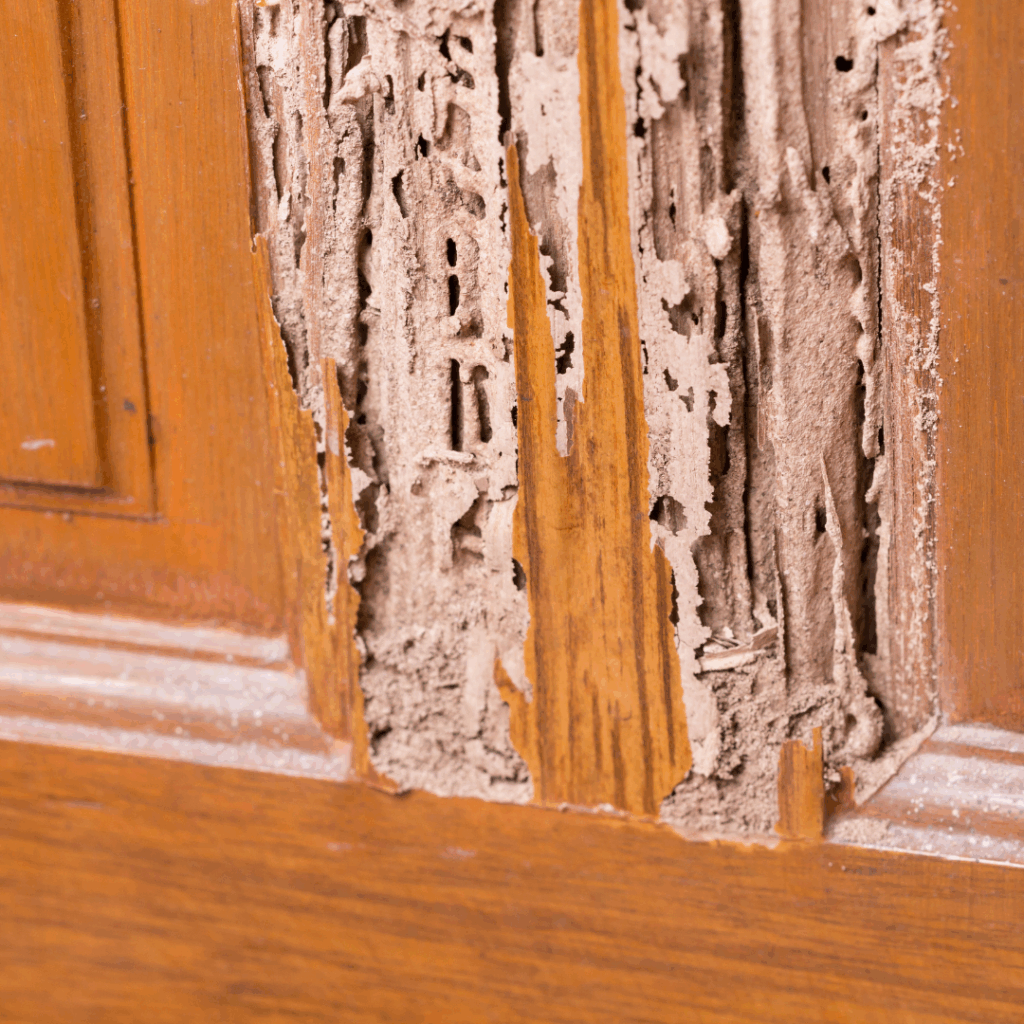
- Damaged wood: Tap your wood framing with a screwdriver handle. If it sounds hollow or looks blistered and structurally thin, termites may have hollowed it out from the inside.
- Packed soil: Look for mysterious dirt packed tightly into drywall cracks or wood crevices.
6. Schedule Annual Professional Inspections
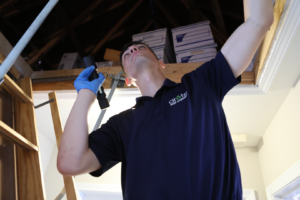
An annual professional termite inspection is the prevention measure with the highest return on investment because it catches activity before it reaches the point where structural repair becomes necessary.
An experienced termite inspector identifies conditions and early signs that homeowners routinely miss during casual observation.
In crawl space construction, inspectors systematically probe floor joists and sill plates, checking for both visible mud tubes and hollow or softened wood that indicate subsurface tunneling.
Slab construction inspections focus on foundation perimeter cracks, utility penetration gaps, and the exterior grade conditions that affect risk.
Both construction types benefit from a professional’s familiarity with the specific signs that distinguish early termite activity from normal wood aging or moisture-related deterioration.
The USDA estimates that more than 1 in 5 homes in high-activity areas have been or will be attacked by subterranean termites.
Annual termite inspections in Georgia can catch termites early before substantial damage has progressed, saving you thousands of dollars in potential repairs.
FAQs
Does mulch attract termites?
Mulch doesn’t actually attract them from far away, but it does create a perfect habitat for them if it’s piled against your house. It traps moisture and keeps the soil cool, which termites love.
To stay safe, just keep mulch pulled back 12 to 18 inches from your foundation, or use gravel right next to the house instead.
Can you prevent termites in new construction?
Yes, and it is the best time to do it. Before the house is fully built, pest control companies can treat the soil underneath and install physical mesh barriers before the concrete slab is poured. Doing this during construction is highly effective and much cheaper than trying to fix a problem later.
How do I know if I have termites or carpenter ants?
You can tell them apart by looking closely at their bodies and the damage they leave behind. Termites have straight antennae, thick waists, and four wings that are all the exact same length.
Their wood tunnels look muddy and dirty because they eat the wood. Carpenter ants have bent antennae, pinched waists, and front wings that are longer than their back wings. Their wood tunnels are perfectly clean because they don’t actually eat the wood; they just chew through it to build nests.
Do termite treatments require digging up the yard?
No, you don’t need to dig up your yard. Liquid treatments just require drilling small, hidden holes near the foundation to inject the product into the soil, which are then patched up. Alternatively, bait stations can simply be placed into the ground around your home without any digging at all.
How much does prevention cost compared to a full treatment?
An annual inspection is usually free if you are enrolled in a monthly plan. If you get an infestation, treating it costs around $500 to $2,000.
However, if termites go unnoticed for years, fixing the structural damage to your home can easily cost over $10,000. Regular inspections save you thousands in the long run.