

If you are buying or selling a home in Georgia, a Wood Destroying Insect (WDI) Report can uncover existing or previous termite damage that might impact the safety and value of your property.
Georgia ranks among the highest termite-pressure zones in the United States due to its humid climate and clay soil. Subterranean termites are active statewide, especially in Northern Georgia counties outside of Atlanta, and homeowners’ insurance rarely covers termite damage.
That means undisclosed structural damage becomes the buyer’s financial liability, even if it was not disclosed or unknown before the sale of a home.
Here is exactly what a WDIR covers, who needs one, what it costs, and what happens if a property fails an inspection in Georgia.
What Is a Wood-Destroying Insect Report?
A Wood-Destroying Insect Report is an official document that records visible evidence of wood-destroying insects or other organisms in a structure. In Georgia, this includes:
- Subterranean termites
- Wood-boring beetles
- Powder post beetles
- Wood-decaying fungi
The report is prepared using the state-approved Form 100. It documents visible findings, identifies inaccessible areas, and distinguishes between active infestation and prior damage.
Note: Inspectors cannot move furniture, open walls, or perform destructive testing. The report covers only what is visible and accessible at the time of inspection.
When Is a Termite Inspection Required in Georgia?
Georgia law does not require a WDIR for every property sale, but most mortgage lenders do. Requirements vary by loan type, as seen below.
|
Loan Type |
WDIR Required? |
Who Typically Pays? |
|
VA Loan |
Yes |
Seller (lender requirement) |
|
FHA Loan |
Yes |
Negotiated — often seller |
|
Conventional Mortgage |
Usually yes |
Negotiated |
|
Refinance |
Often required |
Borrower |
|
Cash Purchase |
Not required by law |
Buyer (strongly recommended) |
Even when not required by a lender, a WDIR is strongly recommended for any Georgia home purchase. The cost of an inspection ($50 to $250) is negligible compared to the cost of undisclosed termite damage, which averages $3,000 or more per home nationally.
Who Pays for the WDIR in Georgia?
Payment responsibility is set by the real estate purchase agreement, not state law. There is no fixed rule.
- Seller pays — standard in most traditional transactions
- Buyer pays — based on negotiation or loan structure
- VA loans — lender typically requires seller to pay
The cost typically ranges from $50 to $250, depending on property size and the pest control company. Confirm payment responsibility before ordering the report — do not assume.
Georgia WDIR Form 100: What the Official Report Must Include
The Georgia Department of Agriculture regulates WDI inspections. A valid Form 100 must include all of the following:
- Inspection conducted by a licensed Wood Destroying Organism (WDO) company
- Written documentation of all visible findings
- Identification of active infestation vs. prior damage
- Disclosure of all inaccessible areas
- Inspector’s signature and license number
- Property address and names of buyer and seller
Reports that do not meet these requirements are not valid for real estate closings in Georgia. Always confirm that your pest control company produces a compliant Form 100, not just a general inspection summary.
How Long Is a Georgia WDIR Valid?
A WDIR is valid for 30 days from the date it is signed. Do not order it too early in the transaction—time it to align closely with your expected closing date.
If an active infestation is discovered within that 30-day window, the issuing pest control company is responsible for treating it.
After treatment is complete, the property is reinspected, and a new Form 100 is issued. The 30-day clock restarts from the new signing date.
What Happens If a Property Fails the WDIR?
A failed WDIR does not automatically end a transaction. Buyers have four options, each with different trade-offs.
|
Option |
What It Means |
Best When |
|
Walk Away |
Buyer cancels the contract |
Damage is extensive or unknown |
|
Renegotiate Price |
Request a reduction to offset repair costs |
Damage is quantifiable |
|
Require Treatment Before Closing |
Seller funds and arranges treatment |
Buyer wants the property, not the problem |
|
Purchase As-Is |
Buyer accepts condition, usually at reduced price |
Buyer has contractors ready |
If treatment is completed before closing, the pest control company issues a clearance letter. A new inspection is then conducted and a fresh Form 100 is issued.
Confirm timelines with your lender, as some have strict closing date requirements that do not flex for treatment delays.
What to Expect During a Georgia Termite Inspection
A standard WDIR inspection takes 30 to 60 minutes for most residential properties. Here is what the inspector does during that time:
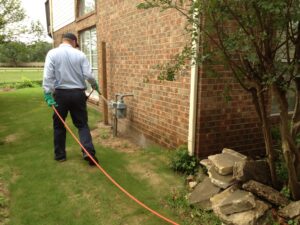
- Examines the foundation, crawl space, basement, and any wood-to-soil contact points
- Checks attic framing and roof structure where accessible
- Inspects visible interior wood: baseboards, window and door frames, support beams
- Documents all findings and inaccessible areas on Form 100
- Notes prior damage separately from any active infestation
After the inspection, you receive the completed Form 100—typically within 24 hours. Your real estate agent and lender will both need a copy.
How to Get a Georgia WDIR
A valid WDIR must be issued by a pest control company licensed to handle wood-destroying organisms in Georgia.
Not all pest control companies carry this license, so be sure to confirm credentials before scheduling.
Ask these questions before booking a pest control inspector:
- Are you licensed by the Georgia Department of Agriculture for WDO inspections?
- Do you produce a Georgia Form 100-compliant report?
- If treatment is needed, can you handle it and reissue the report before my closing date?
Arete Pest Control is licensed statewide to conduct WDIR inspections. Our certified technicians inspect your property, document all findings, and produce a report that meets all Georgia Form 100 requirements. If treatment is needed, we handle that too, keeping your transaction on schedule.
Frequently Asked Questions
Is a WDIR required for cash home purchases in Georgia?
No, cash buyers are not required by law to obtain one. But given Georgia’s high termite pressure, it is strongly recommended. A $50 to $250 inspection is cheap protection against thousands in potential damage.
Can one WDIR be used across multiple offers?
Only if all transactions close within the 30-day validity window. A new inspection is required for each new contract period.
What is the difference between a termite inspection and a WDIR?
A termite inspection is a general term. A WDIR (Form 100) is the official Georgia document required for real estate closings. Confirm your pest control company produces a Form 100-compliant report and not just a general pest assessment.
Does a WDIR cover all household pests?
No. A WDIR covers wood-destroying insects and wood-decaying fungi only. It does not cover cockroaches, rodents, ants, or general pests.
How much does a WDIR cost in Georgia?
Most companies charge $50 to $250 for a standard residential inspection. Larger properties or those with complex crawl spaces may cost more. Confirm pricing when you schedule.
What if the inspector cannot access part of the property?
The inaccessible area is noted on Form 100. Lenders may require those areas to be made accessible before they accept the report. Address access issues before the inspection to avoid delays.
Can the seller dispute a failed WDIR?
Yes. A seller can request a second opinion from another licensed WDO company. Both reports can be reviewed during the negotiation process.
How long does termite treatment take before a re-inspection?
Standard liquid barrier treatments take 24 to 48 hours to set. Bait system treatments may take longer. Confirm your pest control company’s timeline against your closing date before treatment begins.