
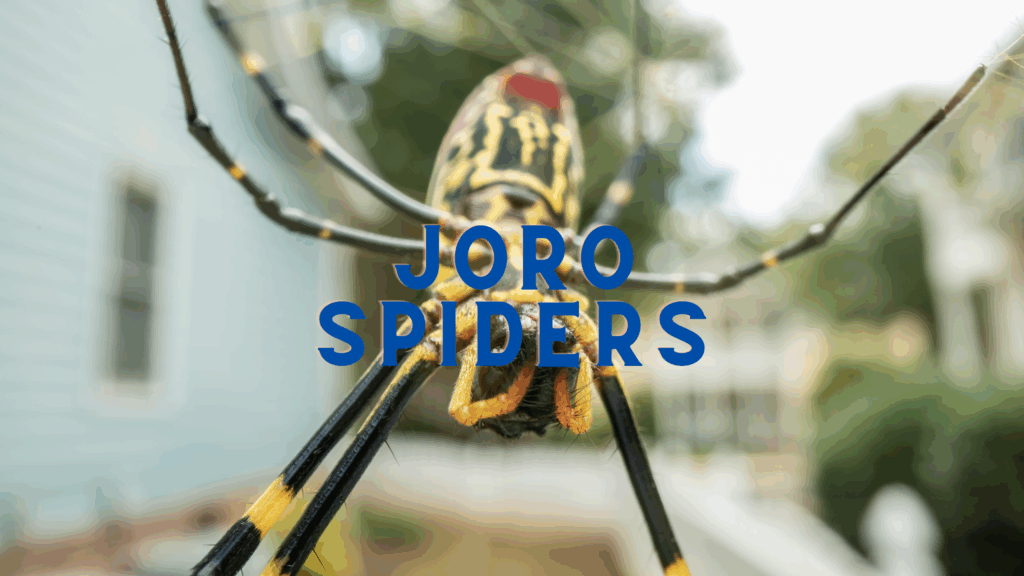
Joro spiders are an invasive species first discovered in Georgia in 2013. Bright yellow, black, and red, with leg spans reaching up to four inches, they build massive golden webs across porches, trees, and power lines all across Georgia.
While relatively harmless to people and local ecosystems, Joro Spiders can quickly reproduce and take over porches and properties with their webs.
If you have spotted one or dozens of these spiders on your property, this guide will help you eliminate them and prevent them from returning.
What is the Joro Spider?
The Joro spider (Trichonephila clavata) is an invasive species from East Asia, native to Japan, China, Korea, and Taiwan.
It arrived in the United States around 2013, first confirmed in northeast Georgia. Since then, it has spread across the entire state, making it one of the most common spiders in Georgia.
University of Georgia researchers found the species is well-adapted to Georgia’s climate. Its metabolism supports survival across a wide temperature range: a key reason it has established itself so quickly here.
Size and Appearance
Female Joro spiders are the ones you will notice. They have:
- Body length up to 1 inch
- Leg span up to 4 inches
- Bright yellow and blue-gray bodies with red markings on the abdomen
- Black legs with distinct yellow bands
Males are significantly smaller and mostly brown, making them incredibly difficult to spot with the naked eye.
Are Joro Spiders Dangerous?
Joro spiders are not dangerous to humans. They are non-aggressive and actively avoid contact. Their fangs are too small to reliably puncture human skin, and bites are extremely rare.
They are venomous, but their venom poses no real threat to healthy humans or pets. If someone in your household has known spider or insect venom allergies, use extra caution; however, for most people, a Joro spider is no more harmful than a common garden spider.
Are Joro Spiders Venomous to Dogs?
Joro spider venom is not considered toxic to dogs or cats. Their small fangs make biting a pet unlikely in the first place. Watch for localized swelling or irritation after any spider encounter, and contact your vet if you notice an unusual reaction.
How to Handle Joro Spider Webs in High Trees
Joro spiders build orb webs: large, circular spiral structures anchored to trees, shrubs, fences, and structures by mooring lines. A single web can span several feet, and during peak season, you may find dozens in a single yard.
For webs in trees or high locations, a telescoping cobweb removal brush is the most practical tool. Twist the brush into the web to collect it, then dispose of it–no chemicals required, no harm to surrounding plants.
For webs on structures like porches and eaves, a standard broom works well. Consistently knocking down webs discourages spiders from rebuilding in the same spot.
Impact of Joro Spiders on the Georgia Ecosystem
Joro spiders are a nuisance, but they are not considered harmful to local ecosystems. In fact, they do provide some ecological value. They eat mosquitoes, gnats, flies, and stink bugs, and have also become a food source for mud dauber wasps, which prey on black widow spiders.
That said, their sheer numbers and large webs create a real quality-of-life issue, especially in outdoor living spaces. No formal control measures have been established because Joro spiders have minimal direct medical or economic impact, but that does not mean you have to live with them.
How to Get Rid of Joro Spiders: Best Methods
The right elimination method depends on how widespread the infestation is and where the spiders are located on your property.
Method Comparison Table: DIY vs. Professional Removal
|
Method |
Best For |
Effectiveness |
Notes |
|
Broom / Cobweb Brush |
Porch & low webs |
High — immediate |
No chemicals needed |
|
Insecticide Spray |
Active infestation |
Moderate |
Can harm pollinators |
|
Direct Contact Kill |
Individual spiders |
High |
Wear gloves |
|
Professional Treatment |
Large or heavy infestation |
Very High |
Targeted, safer for yard |
How to Stop Joro Spiders from Taking Over Your Porch
Porches are prime Joro spider territory, as they offer everything they need to survive: shelter, light, and anchor points.
Here is how to keep them away:
- Remove webs every 2 to 3 days during peak season (late summer through fall).
- Switch to yellow-tinted outdoor bulbs, which attract fewer insects and fewer spiders.
- Seal gaps around doors, windows, and siding where spiders could enter.
- Clear dense vegetation near the porch — overgrowth creates easy anchor points.
- Apply a perimeter insecticide spray around the foundation to reduce the insect prey near your home.
Best Way to Kill Joro Spiders Without Harming Honeybees
The safest approach is targeted, direct-contact removal: knock webs down with a brush, and if chemical treatment is needed, apply it directly to the spider rather than broadcast across the yard.
Broadcast insecticide sprays kill indiscriminately. They will eliminate the Joro spiders, but they will also harm honeybees and other pollinators.
For broader treatment, consult a licensed pest control professional who can select the right product and method.
When to Call a Professional Exterminator
DIY methods work well for light infestations. But if webs are covering large sections of your property, you are finding spiders indoors, or removal cannot keep up with population growth, call a professional.
A licensed technician can assess the infestation, apply targeted treatments, and build a prevention plan specific to your property. Arete Pest Control offers free inspections for Georgia homeowners. Contact us today if Joro spiders are taking over your space.
FAQs
Are Joro spiders dangerous to humans?
No. Joro spiders are not aggressive, and their small fangs rarely penetrate human skin. While they are technically venomous (like nearly all spiders), their venom is not considered medically significant to healthy adults.
Will Joro spiders go away on their own?
Adult Joro spiders die off in late fall after the first hard frost. However, egg sacs overwinter and hatch in spring. Without intervention, populations often increase year over year.
Do Joro spiders come inside homes?
Rarely. Joro spiders strongly prefer outdoor environments where they can build large orb webs between trees, deck rails, and structures. Indoor sightings are uncommon and typically accidental.
What kills Joro spiders instantly?
Direct-contact insecticide sprays labeled for spiders are effective. Physical removal with a broom or brush also works. Immediate results require direct contact — residual sprays alone will not kill them instantly.
Are Joro spiders venomous to cats or dogs?
Their venom is not considered toxic to pets. Joro spiders are non-aggressive and unlikely to bite animals. Most pet interactions result in the spider retreating rather than biting.
How fast are Joro spiders spreading in Georgia?
Research from the University of Georgia indicates Joro spiders are expanding rapidly and may spread across much of the Eastern Seaboard. Their cold tolerance allows them to survive in a broader range of climates than originally expected.
Is it bad to kill Joro spiders?
No. Joro spiders are an invasive species. Removing them does not harm Georgia’s native ecosystem in the way eliminating native spider species might.